



Hiring employees in another country can look straightforward from the outside. Find the right candidate, make an offer, and get them started.
The reality is more complicated.
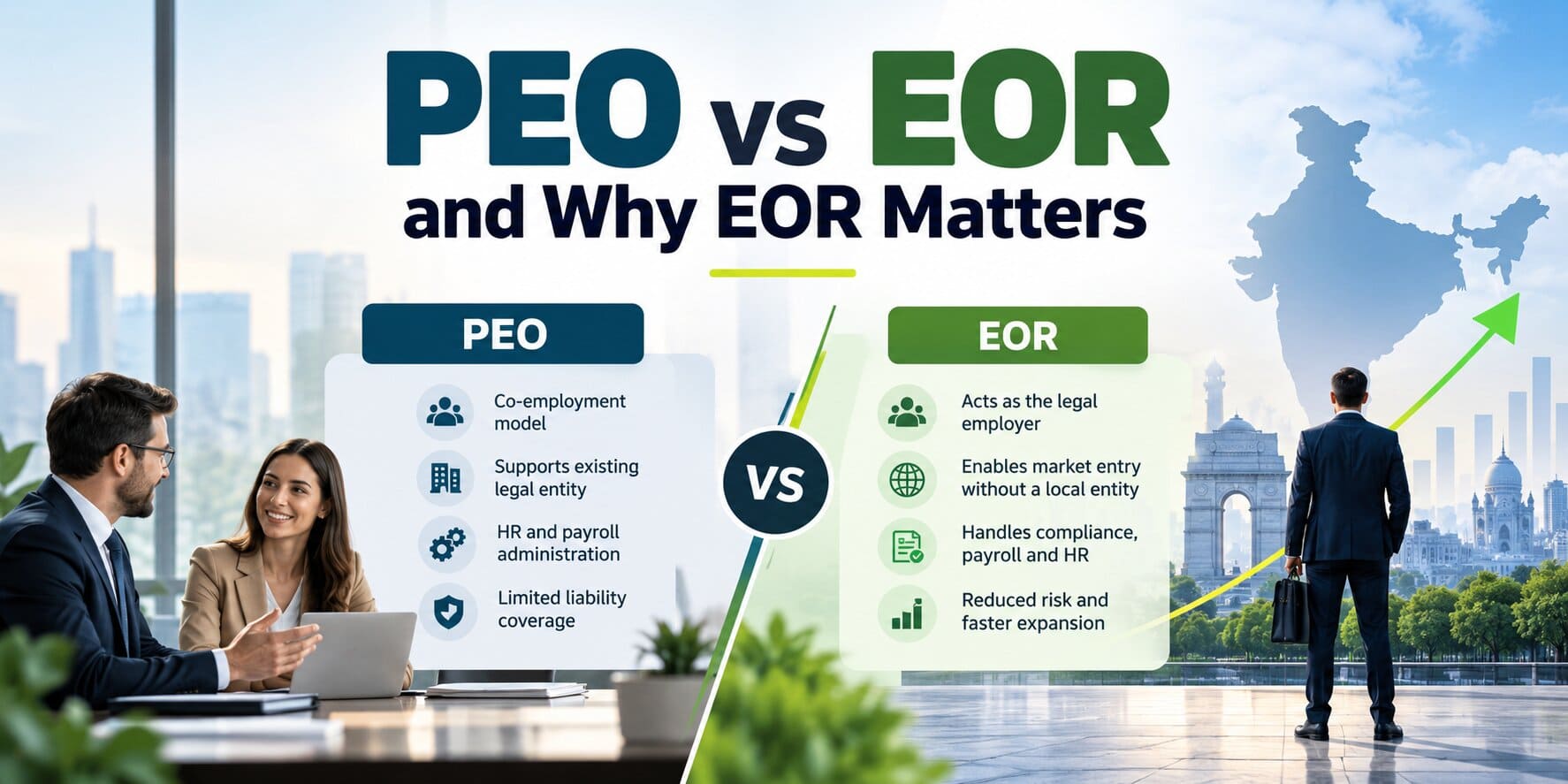
Once a company hires someone in another jurisdiction, it may become responsible for employment contracts, payroll, taxes, statutory requirements, benefits, leave, employee records, and local employment regulations. This is where Professional Employer Organizations (PEOs) and Employer of Record (EOR) services enter the picture.
Although PEOs and EORs are sometimes discussed as if they are interchangeable, they serve different purposes.
For companies planning to build a team in India, the distinction is particularly important. An EOR can provide a practical way to employ people in India without requiring the business to immediately establish and operate its own Indian employment entity.
This guide explains how PEO and EOR models differ, when each may be appropriate, and why EOR services have become an important option for companies hiring internationally.
What Is a PEO?
A Professional Employer Organization (PEO) works with a business through a co-employment arrangement.
In a traditional PEO relationship, the client company already has an employment structure in place. The PEO shares certain employer responsibilities and provides HR and administrative services.
A simple way to understand the model is to think of the PEO as an extension of the company’s HR function.
The business continues to run its operations and manage its employees, while the PEO helps with selected employment-related responsibilities.
What Does a PEO Typically Handle?
Depending on the provider and jurisdiction, PEO services can include:
- Payroll administration
- Benefits administration
- HR support
- Workers’ compensation
- Employment-related compliance support
- Tax administration
- Employee onboarding
- HR policies and documentation
A PEO can therefore be useful when a company already has the appropriate legal structure but wants to outsource or strengthen its HR and employment administration.
When Does a PEO Make Sense?
Consider a company with an established workforce in the United States. The company already has its legal entity, hires employees directly, and manages its operations.
As the company grows, it may decide that managing payroll, benefits, HR administration, and employment compliance internally is becoming inefficient.
A PEO can provide the additional HR infrastructure without changing the company’s fundamental employment structure.
That is different from a company that wants to hire its first employee in another country where it has no legal entity. That situation is where an EOR can become particularly relevant.
What Is an EOR?
An Employer of Record (EOR) provides a different employment structure.
The EOR becomes the legal employer of the employee in the relevant jurisdiction. At the same time, the client company continues to manage the employee’s day-to-day responsibilities, work, objectives, and performance.
This distinction is important.
The EOR manages the employment relationship from the legal and administrative side. The client remains responsible for the actual business relationship and the employee’s work.
A Simple Example
Imagine a software company headquartered in the United States wants to hire five developers in India.
The company has identified the candidates and wants them to join quickly, but it does not currently operate an Indian employment entity.
There are two broad approaches.
Option 1: Establish an Indian entity and build the required employment, payroll, HR, and compliance infrastructure.
Option 2: Work with an EOR that already has the appropriate local employment infrastructure.
With the second approach, the EOR employs the workers locally and manages the employment administration, while the software company manages the developers’ day-to-day work.
This is one of the key reasons businesses consider an EOR when entering a new market.
What Does an EOR Manage?
An EOR’s responsibilities can vary by country and service provider, but commonly include:
- Employment contracts
- Employee onboarding
- Payroll processing
- Applicable payroll deductions
- Statutory contributions
- Benefits administration
- Leave administration
- Employment documentation
- Local employment compliance
- Employee records
- Offboarding and termination administration
For businesses hiring in India, having local expertise can be particularly valuable because employment and payroll requirements need to be managed according to applicable Indian regulations.
PEO vs. EOR: The Difference at a Glance
The most important difference is the employment relationship.
Area
PEO
EOR
Employment structure
Co-employment arrangement
EOR is the legal employer
Existing entity
Generally used with the client’s existing entity
Can support hiring where the client does not have a local entity
HR administration
Shared/support model
Managed by EOR as part of employment service
Day-to-day employee management
Client
Client
Payroll
PEO supports payroll administration
EOR manages payroll as part of employment administration
International hiring
Depends on local structure and provider
Designed for employment across jurisdictions
Local compliance
Supports the client’s existing structure
Manages applicable employment obligations for the EOR-employed worker
Typical use case
HR support for an established workforce
Hiring employees where the company lacks a local employment structure
The easiest distinction to remember is:
- A PEO supports an existing employment structure.
- An EOR provides the employment structure in the relevant jurisdiction.
Why Is EOR Important for Companies Hiring in India?
India has become an important destination for technology, engineering, operations, support, finance, and other professional talent.
But accessing that talent is only one part of the hiring equation.
A company hiring in India also needs an appropriate employment framework.
This is where an EOR can make a significant difference.
1. Hire in India Without Immediately Establishing an Entity
For an international company, establishing a new entity can require substantial planning and ongoing administration.
The business may need to establish the appropriate legal structure, arrange payroll processes, understand local employment requirements, maintain records, and manage ongoing compliance.
An EOR offers another route.
The EOR can employ eligible workers through its local employment structure while the client company focuses on building and managing its India team.
This can be particularly useful when a company wants to test the Indian market, hire a small initial team, or begin recruiting before committing to a larger local operation.
2. Reduce the Complexity of India Payroll
International payroll becomes complicated when a company operates across multiple jurisdictions.
An India-based employee may have payroll requirements that differ significantly from those in the company’s headquarters.
An EOR can manage the local payroll process, including applicable deductions, statutory requirements, payslips, and related employment administration.
Instead of creating an entirely separate payroll operation for a small number of employees, the business can work through an established EOR framework.
3. Navigate Local Employment Requirements
Employment rules are not universal.
Requirements relating to contracts, leave, wages, statutory contributions, employee benefits, working conditions, and termination can vary between countries and, in some cases, between locations within a country.
For an overseas company without local HR expertise, understanding these requirements can be challenging.
An EOR with India-specific expertise can manage applicable employment processes and help the client maintain a structured approach to local employment administration.
Businesses should still obtain appropriate professional legal or tax advice for circumstances requiring specialist interpretation.
4. Start Hiring Faster
Building a new local employment operation takes time.
An EOR can shorten the operational path between finding a candidate and employing that candidate.
For example, a company may identify an excellent engineering candidate in Bengaluru but have no Indian entity.
Rather than putting the recruitment process on hold while building a local infrastructure, the company can explore an EOR arrangement and continue its hiring plan through an established local employment framework.
For companies competing for in-demand talent, reducing unnecessary administrative delays can be valuable.
5. Build a Remote India Team
Remote and distributed teams have changed how companies approach international hiring.
A business does not necessarily need to establish a physical office before hiring employees in another country.
An EOR can support the employment side of a distributed workforce while the client company manages the employee remotely.
This can work particularly well for companies hiring:
- Software engineers
- Developers
- DevOps professionals
- Cloud specialists
- Data professionals
- Customer support teams
- Finance professionals
- Sales and marketing specialists
- Operations professionals
The company can therefore access talent in India without making office expansion the first step.
6. Scale Beyond the First Hire
An EOR does not have to be limited to a single employee.
A company may start with one employee in India and gradually expand to a larger team.
For example:
1 employee → 5 employees → 20 employees → larger India operation
As the workforce grows, the company can evaluate whether continuing with an EOR or establishing its own local entity better fits its long-term strategy.
This flexibility can be useful for startups and businesses entering India for the first time.
EOR Is More Than Payroll
One common misconception is that an EOR is simply a payroll provider.
Payroll is only one component.
An effective EOR relationship covers the employee lifecycle from onboarding through ongoing employment and eventual offboarding.
That can include employment documentation, payroll, benefits, statutory requirements, leave administration, employee records, and termination processes.
The value therefore comes from bringing multiple employment responsibilities into a coordinated structure.
Why International Companies Consider an India EOR
For a company outside India, an EOR can address several practical challenges at once.
Without an EOR
The company may need to:
Create local structure → Build payroll processes → Understand employment requirements → Establish HR administration → Hire employees → Maintain ongoing compliance
With an EOR
The company can instead:
Select candidates → Establish employment through the EOR → Onboard employees → Manage their day-to-day work → Receive ongoing employment administration support
The EOR does not replace the company’s responsibility for managing its business or employees. Instead, it provides the local employment infrastructure needed to support the employment relationship.
PEO or EOR: Which Model Fits Your Business?
There is no universal answer.
A PEO may be appropriate when a business already has an established employment entity and wants additional HR, payroll, benefits, or administrative support.
An EOR may be appropriate when a company wants to hire employees in a jurisdiction where it does not currently have its own employment entity.
For a company planning to hire in India, several questions can help determine which approach deserves consideration:
- Do we already have an Indian legal entity?
- How many employees do we plan to hire?
- Are we testing the Indian market or building a long-term operation?
- How quickly do we need to hire?
- Do we have local HR and payroll expertise?
- Who will manage local employment administration?
- What level of ongoing compliance support do we need?
Answering these questions can help the business determine whether an EOR, PEO, direct employment, or another structure is appropriate.
Choosing an India EOR Partner
The EOR provider becomes an important part of the company’s employment infrastructure. Choosing a provider should therefore involve more than comparing monthly fees.
Businesses should evaluate:
Local Employment Expertise
Does the provider understand the employment environment in India and maintain processes appropriate for local employment?
Payroll Capability
Can the provider reliably manage payroll, applicable deductions, statutory requirements, and employee documentation?
Employee Support
Will employees have access to responsive support when they have questions about payroll, benefits, leave, or employment documentation?
Onboarding and Offboarding
Does the provider have a structured process for both joining and leaving the organization?
Scalability
Can the provider support the business if the India workforce grows from a few employees to a much larger team?
Transparency
Are employment costs, service fees, responsibilities, and processes clearly explained before the relationship begins?
Akross: Helping Businesses Build Teams in India
For international companies looking to hire in India, Akross provides an India-focused Employer of Record solution designed to simplify the employment process.
Akross can support businesses across key stages of the employee lifecycle, including employment, onboarding, payroll, benefits, statutory administration, and ongoing HR support.
- Employment
- Onboarding
- Payroll
- Benefits
- Statutory Administration
- Ongoing HR Support
This gives international companies a structured way to build an India workforce while avoiding the need to immediately create and operate their own local employment infrastructure.
Whether you are planning your first India hire, building a remote technology team, or expanding an existing India workforce, an EOR can provide the local employment framework needed to move forward.
Frequently Asked Questions
Is a PEO the same as an EOR?
No. A PEO generally operates through a co-employment model and supports an existing employment structure. An EOR becomes the legal employer of the worker in the relevant jurisdiction.
Can an EOR help a foreign company hire employees in India?
Yes. An EOR can provide the local employment structure needed for a foreign company to employ workers in India without immediately establishing its own Indian employment entity, subject to the applicable legal and regulatory requirements.
Can an EOR manage payroll in India?
Yes. India EOR services commonly include payroll administration and applicable employment-related deductions and statutory processes.
Does the EOR manage the employee’s daily work?
Generally, no. The client company continues to manage the employee’s day-to-day work, responsibilities, objectives, and performance. The EOR manages the legal and administrative employment relationship.
Is an EOR useful for startups?
It can be. Startups entering India may use an EOR when they want to hire employees without immediately investing in a full local employment infrastructure.
Can an EOR support remote employees in India?
Yes. An EOR can provide the employment framework for eligible remote employees while the client company manages their work remotely.
When should a company establish its own Indian entity instead of using an EOR?
That depends on the company’s long-term plans, workforce size, business activities, regulatory considerations, and professional legal and tax advice. An EOR can be useful during early-stage market entry, while some businesses may eventually choose to establish their own entity as their India operations grow.
Final Takeaway
PEOs and EORs both support payroll, HR, and employment administration, but their employment models differ. A PEO operates through co-employment, while an EOR becomes the legal employer in the relevant jurisdiction.
For international companies hiring in India, an EOR can simplify employment, payroll, onboarding, benefits, statutory administration, and ongoing HR support without requiring the company to immediately establish its own local employment structure.
If you’re planning to hire in India, having the right employment framework is just as important as finding the right talent.
Planning to hire in India?
Explore Akross’s India EOR services or speak with our team about your hiring needs.
